























Don't stop in the face of difficult problems: Lisa Su's important message at MIT convocation
At the MIT Convocation, AMD CEO Lisa Su drew on her academic and career experiences to deliver important messages about tackling tough problems, learning from failure, and the future of AI.
There are times in life when a problem seems so difficult that it seems like there may be no solution. But AMD CEO Lisa Su believes that it is in those difficult places that people can discover their true potential.
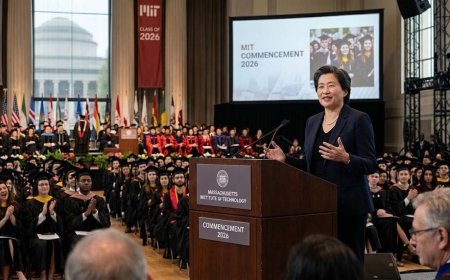
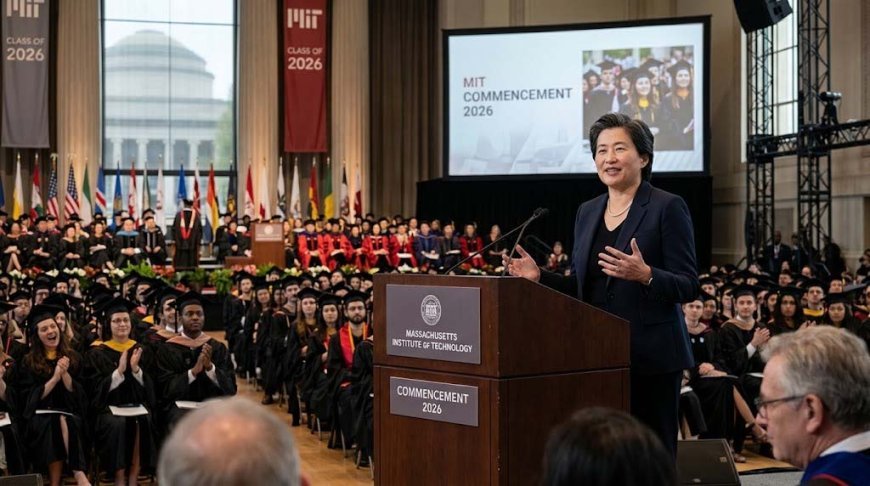
While delivering a speech at the 2026 commencement ceremony of the Massachusetts Institute of Technology, or MIT, in the United States, Lisa Su shared some important experiences about her education, career, and the future of technology. One theme came up again and again in her speech: building the confidence to find the answer to a problem even if you don't know it.
The first shock of going to MIT
Lisa Su went to MIT when she was just 17 years old. At that time, she thought she had a good grasp on mathematics. But after starting classes at the university, her confidence was quickly shaken.
Because there were many students there whose mathematical skills were much higher than she thought. Seeing all the difficult problems and assignments, she initially thought, how will she solve them!
However, this difficult environment gradually changed her.
Through these experiences of repeatedly failing to solve a problem, making mistakes in an exam, or having a circuit not work, she learned that failure does not mean the end.
Rather, when a difficult thing finally works, a new belief is formed within herself:
"I can do it."
The confidence to find the answer even if you don't know it.
For Lisa Su, the biggest lesson at MIT was not just learning a specific technology or subject. Rather, it was developing a mindset where people can admit that they don’t know everything, but can find the answer if needed.
This confidence became very important for her later in life.
The research opportunities while studying at MIT also brought a big change in her life. While working in Professor Hank Smith’s laboratory, she became interested in semiconductor technology. This field became one of the main parts of her identity in her later career.
MIT’s motto is ‘Mens et Manus’, which roughly means ‘mind and hand’. According to Lisa Su, this concept contains an important aspect of MIT’s educational philosophy.
You don’t just have to think. You have to put your thoughts into practice. You have to test. If you fail, you have to try again.
Move on to the hard problems.
After finishing her education and starting a job at IBM, Lisa Su was faced with the situation of proving herself all over again.
IBM was a huge organization at the time. As a young engineer in that environment, she naturally wondered how much of a difference she could make in such a large organization?
It was there that she received an important piece of advice from a mentor:
Move on to the most difficult problems.
As time goes by, he realizes how profound the importance of this saying is.
Because easy problems may be solved quickly, but difficult problems are the ones that give people the opportunity to test their limits. When faced with a complex problem and trying to solve it by breaking it down into smaller parts, a person realizes how capable they really are.
Tough times and big decisions for AMD
Later, Lisa Su took over AMD. At that time, the company was not going through an easy situation.
The big question before them was what AMD wanted to be in the future and which technologies should be emphasized.
Lisa Su and her team saw high-performance computing as an important technology of the future. Then, through long-term planning, research and technological development, AMD began to strengthen their position.
On this journey, she used a method learned at MIT: not being afraid of large and complex problems, dividing them into small parts and moving towards solutions step by step.
The era of AI is ahead.
Technology has changed people's lives several times in the past few decades.
The Internet has changed the way we communicate. Mobile computing has changed daily life. Cloud computing has changed the way we work.
Now comes artificial intelligence, or AI.
Lisa Su believes that the impact of AI could be more profound than many previous technological changes. Because it is not just a means of making people work faster. AI can also accelerate new discoveries and solve complex problems in various fields.
However, this does not mean that AI will eliminate the need for humans.
Rather, AI can act as a powerful tool to further enhance human capabilities.
The future is ultimately in the hands of humans.
No matter how powerful technology is, it will not be technology alone that will determine what the future will be like. People will have to make the decisions.
Technology cannot answer these questions on its own: which problems are most important to solve, which decisions should be made, and who will be responsible for the consequences of those decisions.
Especially in uncertain situations, it is humans who are responsible for making decisions and taking responsibility for those decisions.
Therefore, as AI becomes more advanced, human responsibility will increase.
The biggest lesson
The most important message of Lisa Su's entire speech is very simple:
When faced with a difficult problem, one should not first assume that it is impossible.
You have to break the problem down into smaller parts. You have to test it. If you make a mistake, you have to try again. If you don't know the answer, you have to find the answer.
Because sometimes the problem that seems impossible today may be the biggest learning opportunity for us in the future.
And believing in yourself doesn't mean knowing all the answers.
Believing in yourself means believing that you have the ability to find the answer even if you don't know it.
What's Your Reaction?
 Like
0
Like
0
 Dislike
0
Dislike
0
 Love
0
Love
0
 Funny
0
Funny
0
 Angry
0
Angry
0
 Sad
0
Sad
0
 Wow
0
Wow
0