























Gas Shortage Disrupts Bangladesh Factories as Production Comes to a Halt
A growing gas shortage is disrupting factories across Bangladesh, forcing more than 100 factories to halt production while others operate at reduced capacity. Here's what the crisis means for industries, businesses and consumers.
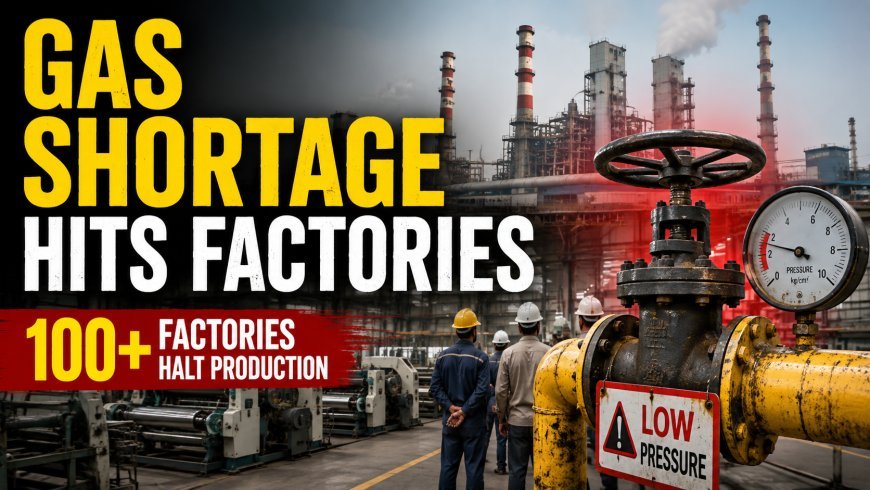
A worsening gas shortage is putting pressure on Bangladesh's manufacturing sector with more than 100 factories reportedly stopping production and many others operating well below capacity.
The disruption is being felt across several major industrial areas including Narayanganj Narsingdi Chattogram Gazipur Savar Mymensingh Habiganj and Khulna. Factories producing essential goods pharmaceuticals ceramics steel textiles and other industrial products are among those facing difficulties.
For companies that depend heavily on natural gas the problem is not simply about lower production. When gas pressure falls too far boilers industrial equipment and gaspowered generators can become difficult or impossible to operate.
That leaves manufacturers with an uncomfortable choice: reduce production temporarily shut down or turn to more expensive alternative fuels.
More Than 100 Factories Reportedly Shut Production
Industry representatives told Prothom Alo that gas supply problems had been continuing for around a month with the situation becoming considerably worse during the week covered by the report.
More than 100 factories in several industrial regions had reportedly stopped production during that period. A large portion of the affected businesses produce everyday consumer goods. Another 150 or more factories were still operating but had significantly reduced their output.
The situation is particularly difficult for factories that cannot simply switch to another energy source.
Some manufacturers are trying to keep operations running whenever gas pressure temporarily improves. Others have turned to diesel but that comes with a substantially higher operating cost.
For businesses already dealing with rising production expenses the additional fuel bill creates another layer of financial pressure.
Essential Goods Manufacturers Face a Serious Challenge
The shortage is particularly concerning for manufacturers of everyday products.
Narayanganj and Chattogram are home to numerous factories involved in processing sugar wheat edible oil pulses and other essential commodities. According to the report roughly half of the relevant factories in those areas had temporarily stopped production because of the gas shortage.
Large industrial groups have also been affected.
Meghna Group of Industries for example reportedly had 40 of its 57 factories shut at the time of the report with many of those facilities involved in essential goods.
TK Group also reported widespread production disruptions among its gasdependent factories around Dhaka.
The concern now extends beyond factory floors.
When production falls for an extended period manufacturers may eventually struggle to maintain normal supplies to wholesalers and retailers. That can create pressure on both product availability and prices.
Sugar and Cooking Oil Supply Under Pressure
The effect of the gas shortage is already visible in parts of the wholesale market.
In Narayanganj's Nitaiganj wholesale market no sugar trucks reportedly entered for three consecutive days during the period covered by the report. The supply disruption was accompanied by an increase in the wholesale price of sugar.
Edible oil production has also been affected.
Meghna Group's edible oil refinery in Narayanganj reportedly suspended production for several days because of the gas shortage. The facility has a production capacity of around 2 500 tonnes a day.
City Group's edible oil facility in Rupganj was also operating at a significantly reduced level with production reportedly falling to around 1 000 tonnes a day from a capacity of approximately 2 500 tonnes.
Manufacturers are trying to manage the situation by using existing inventories.
Some companies have reduced the amount of product they release into the market each day so that available stocks last longer.
That may help prevent an immediate shortage but it is not a longterm solution.
Gas Problems Are Hitting Steel Ceramics and Pharmaceuticals
The impact is not limited to food and consumer goods.
RAK Ceramics Bangladesh reportedly halted production at its four manufacturing units after its gas supply was interrupted.
Steel manufacturer BSRM has also faced gassupply problems. The company has been using diesel as an alternative fuel to keep part of its production running. But diesel costs considerably more meaning the company has had to accept higher production expenses while operating below normal capacity.
The pharmaceutical industry faces an additional complication.
Square Pharmaceuticals has reportedly been using diesel to operate two gasdependent facilities in Pabna and Kaliakoir.
For pharmaceutical manufacturers shutting down a plant is not as simple as switching off a machine and restarting it later. The production process can require significant preparation before operations can safely return to normal.
That makes prolonged gas shortages particularly difficult for the sector.
Chattogram Factories Are Also Feeling the Pressure
Chattogram and surrounding industrial areas are among the regions facing serious energy constraints.
According to information cited in the report at least 35 factories in the area were experiencing production disruptions. Four had reportedly stopped completely while another 10 to 12 had temporarily suspended operations.
The Chattogram Export Processing Zone is also under pressure.
Factories in the zone require substantial gas supplies to support electricity generation. The available gas supply was reportedly around half of what was required for the relevant powergeneration capacity.
Textile and dyeing factories have consequently been among those struggling to maintain normal production.
Some businesses have started using diesel instead of gas but that again increases production costs.
Narsingdi's Textile Industry Faces a Severe Blow
Narsingdi is particularly important to Bangladesh's textile supply chain.
The district has more than 3 000 textile dyeing and spinning mills according to figures cited in the report. A large share of the country's locally produced fabric comes from the region.
But gasdependent factories in Narsingdi have been hit hard.
The report says around 90 percent of gasdependent factories in the district were completely shut during the period covered while average production at affected factories had fallen to roughly 10 percent of normal levels.
For textile manufacturers the consequences can extend beyond today's production loss.
Lower output can make it harder to meet delivery schedules particularly when factories are working against fixed deadlines for domestic buyers or international customers.
ExportOriented Businesses Are Feeling the Heat
The energy shortage is also creating problems for exportfocused manufacturers.
In Habiganj more than 100 industrial establishments were reportedly receiving less gas than they needed. More than half of those businesses were exportoriented.
Some factories had to stop production after gas supplies were interrupted for several days.
For exporters the timing is especially sensitive.
A factory can potentially absorb a short interruption. But repeated shutdowns make production planning much harder. Orders still have deadlines workers still need to be scheduled and shipments still need to leave on time.
If energy shortages continue exporters may face higher production costs as well as difficulties meeting delivery commitments.
Khulna's Frozen Food Industry Faces Higher Costs
Khulna's seafood processing industry is facing a different version of the same problem.
The region plays a major role in Bangladesh's frozen shrimp and fish exports. With shrimp production in season uninterrupted electricity is particularly important for processing plants and coldstorage facilities.
Loadshedding has forced some businesses to operate generators and use diesel to keep refrigeration systems running.
That increases operating costs at a time when manufacturers are already dealing with other pressures.
The problem is especially serious for cold storage because the products cannot simply be left without power for extended periods.
What Happens If the Crisis Continues?
The immediate concern is production.
The bigger concern is what happens if the shortage lasts for weeks rather than days.
Factories may continue using stored inventory to maintain market supplies but those reserves are finite. Companies may also ration daily deliveries to prevent warehouses and retail channels from running empty.
If production remains depressed for too long several effects could appear at the same time:
- Lower factory output
- Higher manufacturing costs
- Increased dependence on diesel
- Delays in product deliveries
- Pressure on export orders
- Reduced working hours in some factories
- Greater uncertainty for workers
- Possible increases in consumer prices
The impact will not necessarily be the same across every industry. Some companies have alternative fuel arrangements while others are almost completely dependent on natural gas.
That difference could determine which businesses are able to continue operating and which are forced to shut down.
Gas Supply Has Started to Improve
There is at least some relief.
Gas supply reportedly increased after the Summit LNG terminal resumed full operations while the Excelerate Energy terminal returned partially. The improvement began early in the day although industry officials indicated that restoring normal supply could still take several days.
According to Petrobangla figures cited in the report national gas demand is around 3.8 billion cubic feet per day. Supply of roughly 3 billion cubic feet would allow most sectors to maintain a relatively stable supply while normal operations already involve some degree of rationing.
At one point during the recent disruption total national gas supply fell to around 1.73 billion cubic feet per day before increasing to approximately 2.44 billion cubic feet.
That improvement is significant but it does not immediately erase the gap between demand and supply.
The Bigger Issue for Bangladesh's Industry
Bangladesh's manufacturing sector cannot plan around unpredictable energy supplies indefinitely.
Factories need reliable gas and electricity not only to operate machinery but also to plan production manage workers control costs and meet customer commitments.
Using diesel as a backup can keep a factory alive temporarily but it is an expensive solution. Smaller manufacturers may have far less ability to absorb those additional costs than large industrial groups.
That is why the current gas shortage is more than an energy problem.
It is becoming a business continuity problem.
If supply stabilizes quickly manufacturers may gradually return to normal production and rebuild inventories. If shortages continue however the pressure could spread from factories to supply chains exporters workers and eventually consumers.
For Bangladesh's industrial economy reliable energy is not a luxury. It is one of the basic conditions required to keep production moving.
And right now that foundation is under serious pressure.
What's Your Reaction?
 Like
0
Like
0
 Dislike
0
Dislike
0
 Love
0
Love
0
 Funny
0
Funny
0
 Angry
0
Angry
0
 Sad
0
Sad
0
 Wow
0
Wow
0